

Authored by the Employment Service of Slovenia. Edited for the blog by Impact Hub Network.
The Coastal-Karst region has farms, local organisations and services that could help create employment pathways for people facing barriers to the labour market. What would it take to connect these resources through social farming?
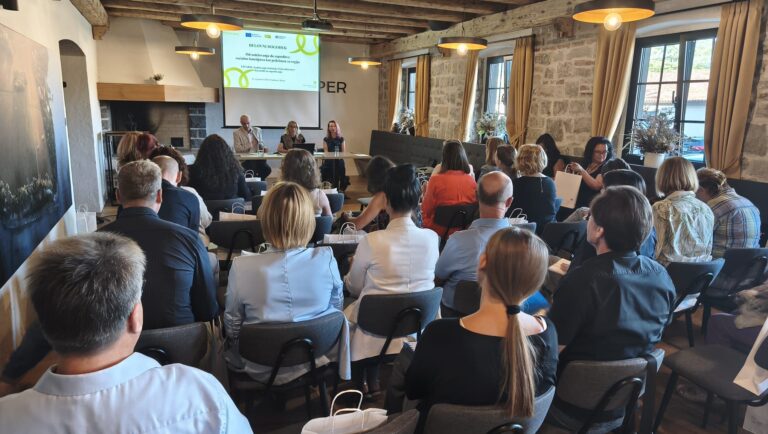
On 15 September 2026, the Employment Service of Slovenia (ESS) brought together 40 participants at Vinakoper in Koper to explore this question. Organised within the European UPFARM project, the event examined how lessons from Tuscany could inform an approach suited to the region.
The discussions identified promising local opportunities alongside practical challenges. Participants emphasised that employment pathways need to reflect individual needs, farms require support from other services, and partners need clear responsibilities before activities can be tested.
Learning from Tuscany
UPFARM explores social farming as a pathway towards employment for long-term unemployed people. It brings agricultural working environments together with learning and individualised support to help people develop skills and move towards employment and greater independence.
In Tuscany, the approach being developed and tested combines local networks of farming enterprises with multidisciplinary support. These networks help create employment opportunities, while professionals work together to match people with suitable environments and support their participation.
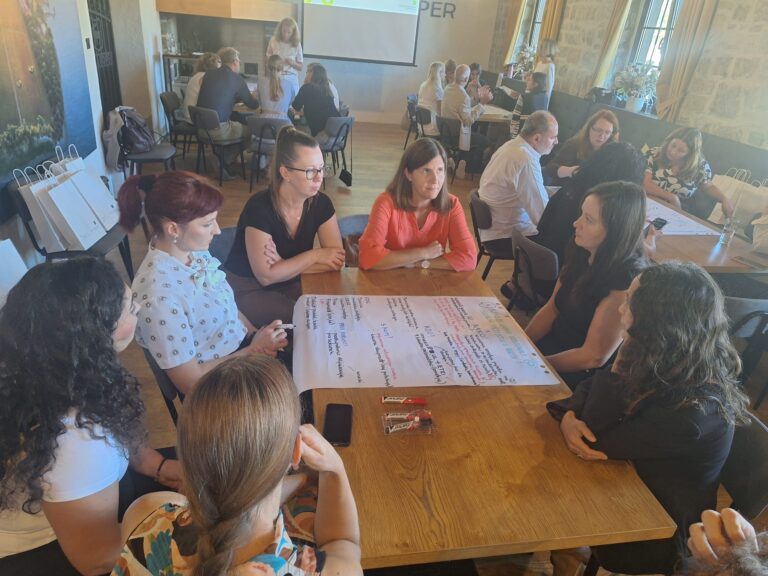
For ESS, the task is to understand which elements could work in Slovenia and what would need to change. The regional event, “From Cooperation to Employment: Social Farming as an Opportunity for the Region”, introduced the Tuscan experience before inviting participants to explore local needs and possibilities through a World Café.
Matching opportunities to the person
One of the clearest findings was that social farming should begin with the individual.
Participants identified several groups who could potentially benefit, including long-term unemployed people, young people, migrants and people returning to the labour market after a longer absence. They also considered people facing health, social or personal barriers.
However, belonging to a particular group does not establish whether an opportunity is suitable. A person’s abilities, interests and motivation need to inform the match, alongside the support they require.
For employment services, this means understanding both the person and the working environment. An available activity needs to offer a realistic pathway towards employment, with conditions that enable the individual to participate and progress.
Participants highlighted mentoring, training and professional and psychosocial support as important requirements. Stability, safety and acceptance within the working environment also matter.
Farms and other host organisations cannot be expected to provide all this support themselves. Cooperation with employment, social and health services is therefore central to developing an approach that can respond to individual needs.
Building on regional opportunities
The World Café identified a range of existing agricultural activities that could provide a starting point, including tourism farms, olive growing, viticulture, herb and vegetable production, beekeeping and fruit growing.
Participants also discussed fisheries, salt production, landscaping, hospitality, tourism and reuse activities as possible opportunities within a broader local inclusion approach. Further exploration would be needed to establish how these activities could connect with social farming and employment pathways.
The discussion suggested that the region may be able to build on existing organisations, working environments and partnerships. The next task is to identify where there is both interest in cooperation and the capacity to support participation.
This gives the regional process a practical focus: assessing which existing opportunities could become suitable working environments, and what support would make that possible.
Clarifying responsibilities and addressing barriers
Participants recognised that cooperation needs a clear operational structure.
Before testing an approach, partners would need to establish who identifies and prepares participants, who provides the workplace, and who delivers mentoring and professional support. Coordination and long-term financing would also need to be addressed.
Potential partners include farms and other employers, municipalities, employment and social services, educational institutions, NGOs and local development organisations.
The discussions identified barriers that could affect implementation, including shortages of specialised staff, administrative obstacles and limited financing. Participants also highlighted the need for better information, more flexible forms of participation and a clearer legal and organisational position for social farming.
Further work will need to examine which requirements can be met through existing programmes and services, and where adaptations may be necessary.
Moving towards practical testing
The event provided an initial picture of regional opportunities and the conditions needed to develop them.
Participants proposed further meetings between interested partners, a more detailed analysis of regional needs and the identification of farms and organisations willing to cooperate. They also suggested exploring concrete activities around which an inclusion approach could be developed.
A small-scale pilot was raised as one possible next step. This could bring together a specific working environment and a selected group of participants, supported by appropriate mentoring and professional services. It remains a proposal to explore.
Through UPFARM, ESS will continue connecting stakeholders, examining regional needs and learning from European experience. The next stage is to assess where there is sufficient local interest and support to develop a feasible approach, and what would need to be in place before testing begins.
About the event
“From Cooperation to Employment: Social Farming as an Opportunity for the Region” was organised by the Employment Service of Slovenia (ESS/ZRSZ) on 15 September 2026 at Vinakoper in Koper, within the European UPFARM project and in cooperation with the Učne delavnice+ and Sodelovanje institucij projects.
The event brought together 40 participants, with perspectives from employment, agriculture, social inclusion, local development and funding. Contributions were provided by the Employment Service of Slovenia, Vinakoper, Eko socialna kmetija Korenika, CSD Južna Primorska – Barčica, PINA and LAS Istre.